Empire of Eldara
Big Picture
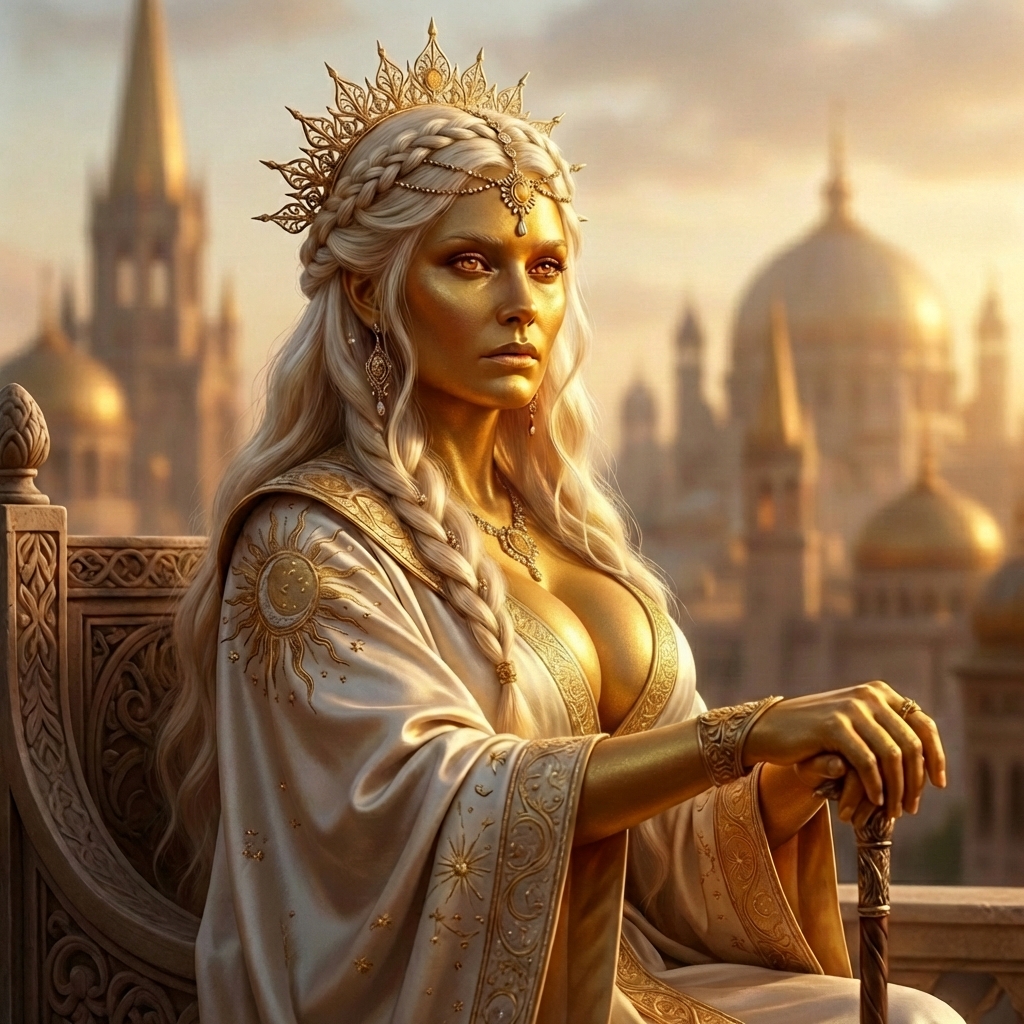
The Empire of Eldara is the dominant force in Tavrenne, ruling from its gleaming capital Valtharion, a city famed for towering spires and ancient halls of wisdom. Founded over two millennia ago during the Age of Conquest, Eldara evolved from warring kingdoms into a unified Empire under Emperor Kaelith Avarion, known as the “Eternal Flame.” Today, the Empire is led by his descendant, Empress Lyssara Valenwyth, whose reign is marked by both enlightenment and unrest.
Key Features
Governance
Imperial Senate
- Composed of representatives from conquered territories, the Senate has limited power, serving as a tool for pacification rather than genuine autonomy.
- The Empire’s legal framework, the Codex Solaris, codifies imperial authority and regulates everything from magical licensing to criminal law.
Caste System
Society is rigidly divided into castes, with the nobility, scholars, and warriors occupying the highest tiers, while peasants and laborers remain at the bottom. Social mobility exists but is rare. This hierarchy extends into the courts, where a formal testimony hierarchy determines whose word carries legal weight.
Military
See full details in The Imperial Military.
The Silver Legion
The Empire’s elite army, known for their unyielding discipline and use of enchanted weapons.
The Justiciar Order
A group of elite enforcers who maintain imperial law, feared for their ruthlessness and incorruptibility.
The Imperial Armada
A fleet of airships patrolling Eldara’s skies and rivers, securing trade routes and defending the borders.
Religion
- Worship of the Seven Covenari (The High Ones), remnants of the gods that once ruled Kaelara. The Empire actively suppresses dissenting religions to maintain unity.
- The Sanctum of Solphirion in Valtharion serves as the Empire’s spiritual heart, where rituals are performed to honor the god of Balance.
Economy
Erythium
The Empire of Eldara dominates trade in Tavrenne, securing its power through the extraction and trade of Erythium, a luminous crystalline ore used for enchanting, technology, and rituals. Erythium’s shimmering red and gold hues make it not only a symbol of wealth but also a cornerstone of magical and technological advancement. Erythium’s properties include:
- Arcane Conduction: Channels and amplifies magical energy, making it vital for creating enchanted artifacts.
- Temporal Stability: Can stabilize rifts in reality, a key element in repairing damage from unstable magic fields.
- Celestial Synchronization: Reacts uniquely to celestial alignments, unlocking greater magical potential for those attuned to it.
The Empire tightly controls the mining and distribution of Erythium, ensuring that no other faction can rival its influence. However, rumors of dwindling Erythium deposits have sparked unrest and fierce competition across Tavrenne.
- Major cities like River-Cross and Port-Siren act as hubs for artisans, merchants, and scholars.
Factions within Eldara
Imperial Loyalists
Devout supporters of the Empire, ranging from noble houses to common folk benefiting from its stability.
The Thousand-Petal Court
Formerly known as the “Veil-Touched Rebellion,” this group of Crisaels seeks to overturn the order of the world through radical crystalline metamorphosis.
The Iron-Guilds
The industrial masters of Ironridge. They control the Erythium trade and the technology that keeps the Empire’s airships afloat. While technically subjects, their stranglehold on resources gives them immense leverage.
Political Relations
The Empire likes to present itself as a unified state. It is not. It is a patchwork of annexed territories held together by military force, economic dependency, and the declining authority of the Heavens’ Covenant. Every province has its own relationship with the Throne, and none of them are simple.
Velmere — The Loyal Core
Status: Fully integrated. Seat of power.
Velmere does not have a relationship with the Empire — it is the Empire. The Auriel nobility, the Imperial Senate, the Sanctum, the military command — all headquartered in Valtharion. Velmere’s interests and the Empire’s interests are functionally identical, which is why the outer provinces trust neither.
Greystone — The Resentful Provider
Status: Loyal but increasingly restless.
Greystone feeds the Empire. Its grain fills Valtharion’s granaries, its timber builds the Armada’s ships, and its taxes fund half the military. In return, the Tharuns receive no representation in the Senate, no Auriel titles, and no say in how their surplus is distributed. The relationship is extractive and everyone involved knows it. The druids of Greystone speak of a “reckoning harvest” — the day the farms stop producing for the capital and start producing for themselves. That day has not come. But the Tharuns are talking about it more openly than they used to.
Blackmoor — The Watched Province
Status: Contained. Distrusted.
The Empire stations a permanent Justiciar garrison at the Blackmoor border, officially to “protect” the Umbrics from Veil anomalies. In reality, the garrison watches for unlicensed mages, Severith worship, and any sign of organized resistance. Blackmoor’s governor is always an Auriel appointed from Valtharion, never a local. The Umbrics tolerate this because open rebellion would bring the Silver Legion, and they are not ready for that fight. The Justiciar reports describe Blackmoor as “compliant but opaque,” which is the intelligence community’s way of saying they have no idea what is actually happening there.
Ironridge — The Indispensable Rival
Status: Autonomous in practice. Cooperative under duress.
The Iron-Guilds control the Erythium supply. The Empire needs Erythium for its military, its economy, and its magical infrastructure. This gives Ironridge leverage that no other province possesses. The Guilds pay their taxes, supply the Empire’s ore, and maintain the legal fiction of Imperial authority in their territory. In exchange, the Empire stays out of Guild internal affairs — labor law, education, mining operations, and justice are all handled by the Guild Council. It is the closest thing to genuine autonomy within the Empire, purchased entirely by economic necessity.
Ravance — The Disloyal Ally
Status: Nominal loyalty. Active subversion.
Ravance pays its taxes and contributes Tirael navigators to the Armada. Beyond that, it does whatever it wants. The harbormasters of Port-Siren look the other way when Crimson Compact ships dock for repairs. Tirael sailors move freely between Imperial service and pirate crews. The Empire knows this and lacks the naval strength to stop it without losing the Tirael navigators it depends on. The relationship is a mutual hostage situation dressed up in diplomatic language.
Caldrith — The Unbroken North
Status: Annexed. Ungovernable.
The Vaeryns were conquered during the Age of Conquest but never pacified. Caldrith resists Imperial authority in every way short of open war — and occasionally including open war. The Vaeryns refuse Imperial courts, ignore the Codex Solaris, worship the Great Wolf in defiance of heresy laws, and raid Imperial supply convoys when they think they can get away with it. The Empire maintains a token garrison at Frost-Hold that spends most of its time trying not to freeze. The Vaeryns have been smelling the Empire’s weakness and their raids are growing bolder.
Zarnath — The Isolationist
Status: Technically Imperial. Functionally independent.
The Ashveils care nothing for Imperial politics. Zarnath trades when it suits them, ignores the Empire when it does not, and treats Imperial governors as guests who have overstayed their welcome. The desert makes military enforcement nearly impossible — the Silver Legion learned this during two failed expeditions in the Age of Conquest, when entire companies were swallowed by sandstorms and never found. The Empire maintains formal sovereignty over Zarnath because admitting otherwise would encourage other provinces. The Ashveils maintain the pretense because it costs them nothing and occasionally provides useful trade access.
Havenwood — The Sealed Kingdom
Status: Independent in all but name.
The Sylvaels sealed Havenwood’s borders after the Violation of the Grove and have never fully opened them. The Empire claims Havenwood as a province. The Sylvaels do not recognize this claim and no Imperial governor has successfully entered the deep forest and returned to enforce it. Trade happens at the forest edge — Sylvael ironwood and herbs in exchange for metals and finished goods. Beyond that, the Empire knows almost nothing about what happens inside Havenwood. Diplomatic envoys are received politely, listened to patiently, and sent home with gifts and no concessions.
Kaelroch — The Prison Colony
Status: Exploited. Neglected.
Kaelroch is barely a province and more of a resource extraction site. The Empire’s primary interest is Cindralium and volcanic minerals. The Emberkin population is too small and too dispersed to threaten Imperial control, and the inhospitable terrain means no one else wants the territory. The Empire runs Cinder-Gate as a penal colony and otherwise ignores the region. The Emberkin, for their part, are content to be ignored. The erupting volcanoes concern them far more than Imperial politics.