The Severith
The Severith (or Nether-Lords) are the divine entities who refused the Heavens’ Covenant or were shattered by it. They are not a unified pantheon but rather distinct cosmic threats, each pursuing their own form of ruin.
Worship of the Severith is strictly forbidden by the Empire of Eldara, though secret cults and desperate mortals turn to them for power.
Imperial Propaganda vs Reality
The Empire teaches that the Severith mirror the Covenari in number — seven against seven, darkness against light. This is a lie of convenience. The truth is messier. One Severith is dead, consumed by another. And one entity the Empire classifies as Severith doesn’t fit the category at all. The real count is five active Nether-Lords, one dead god’s echo, and one being that refuses every label mortals try to pin on it.
What the Empire also will not teach is this: the Severith are not a team. They do not coordinate. Most of them hate each other as much as they hate the Covenant. Karnath-Magar and Varia have been at war for longer than The Empire has existed. Avaros would sell any of them out for the right price. And Malakor does not distinguish between Covenari and Severith — in the end, he intends to unmake them all. The only thing the Nether-Lords share is a refusal to be bound. Everything else is conflict.
The Five Active Severith
1. Malakor, The Void
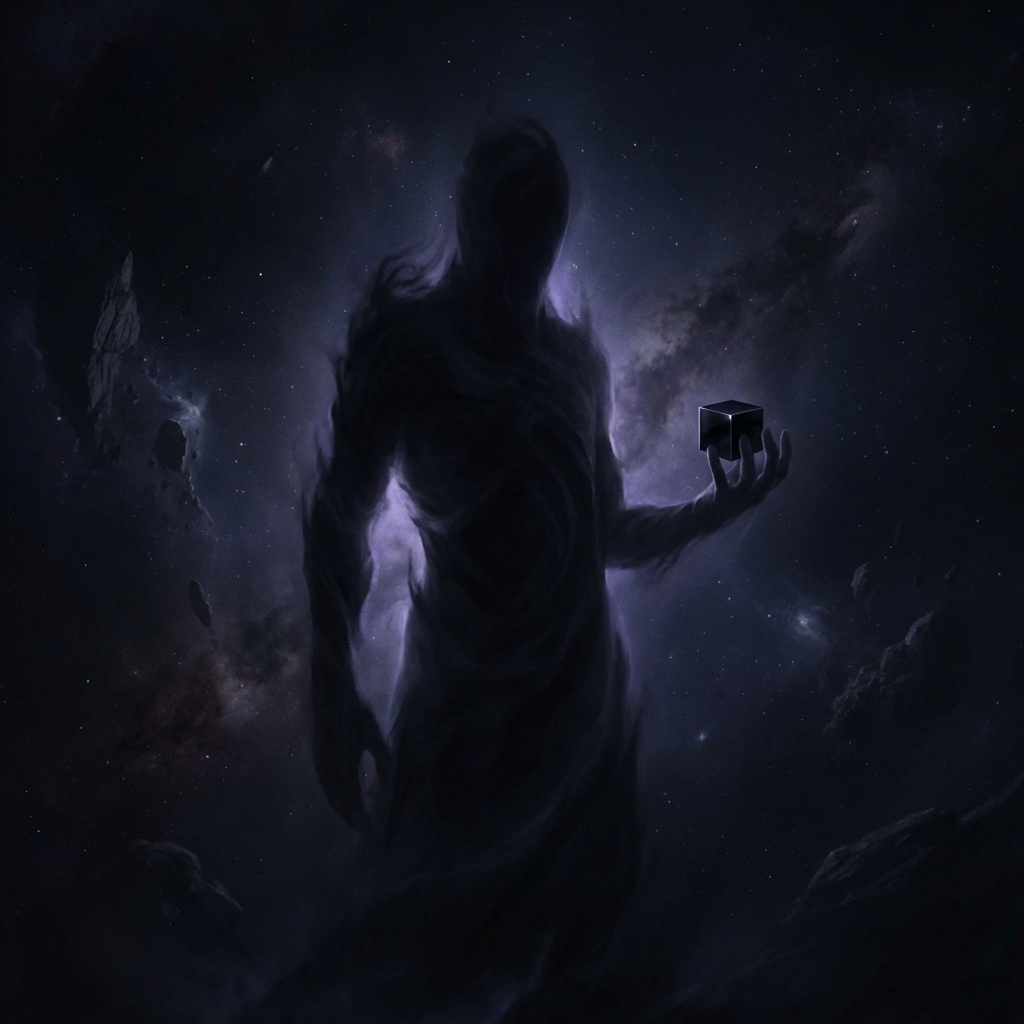
Title: The World-Breaker Realm: The Void Between Stars
- Domain: Entropy, Unmaking, Silence, The End.
- Followers: Nihilists, Void-mages, and those who seek oblivion.
Malakor is not evil. That is what makes him terrifying.
Evil requires intention, requires caring enough about something to want to hurt it. Malakor does not care. He is the cold vastness between stars, the silence that exists before sound and after it, the nothing that was here first and will be here last. He possesses no hatred for mortals. He does not hate the Covenari. He does not hate the other Severith. Hatred is noise, and Malakor is the absence of noise.
He views existence as a mistake — not a moral failing, just an error. A brief, chaotic disruption in the perfect stillness that should be. Stars burn, mortals scream, gods argue, and all of it is just static. Malakor wants what was here before: peace. Absolute, final, total peace. The peace of a universe that has stopped pretending it needs to exist.
This is not a philosophy he arrived at. It is what he is. Asking Malakor to stop seeking entropy is like asking gravity to stop pulling. He is the fundamental force of undoing, the thermodynamic truth that all things end. The Covenari did not defeat Malakor during the Shattering Age. They just slowed him down.
And he has been getting faster.
During the Age of Reclamation, Valdris — the god of tyranny and false glory — made a bid to crown himself Lord of the Severith. He marched into the Void Between Stars to challenge Malakor directly. What happened next took centuries. Malakor consumed him. Not in battle. Not in some dramatic clash of divine power. He simply… absorbed him, the way deep water absorbs a stone. Slowly. Completely. Without apparent effort. Where once Malakor was patient, he is now hungry. Valdris’s ambition did not disappear when it was consumed. It became part of the Void. And a Void with ambition is something the cosmos has never had to face before.
The other Severith fear him. Even Karnath-Magar, who fears nothing else, keeps his distance from the Void Between Stars. Nocnitsa will not hunt in Malakor’s territory. Varia cannot corrupt what has no desire. And Avaros — the great dealmaker — has nothing Malakor wants, because Malakor wants nothing. That is the problem. There is no negotiating with entropy. There is no bargain to be struck with the end of all things.
Malakor struck the moon Nythra in 1A 487, cracking it permanently and destabilizing the Leylines across all of Kaelara. Some scholars believe this was not an attack on Lunarae but a test — Malakor probing the Veil’s defenses the way a patient hand tests the thickness of ice before stepping onto it.
He is the supreme threat. Not because he is the strongest — though he may be. Because he is the most inevitable.
2. Karnath-Magar, The Flayed Lord
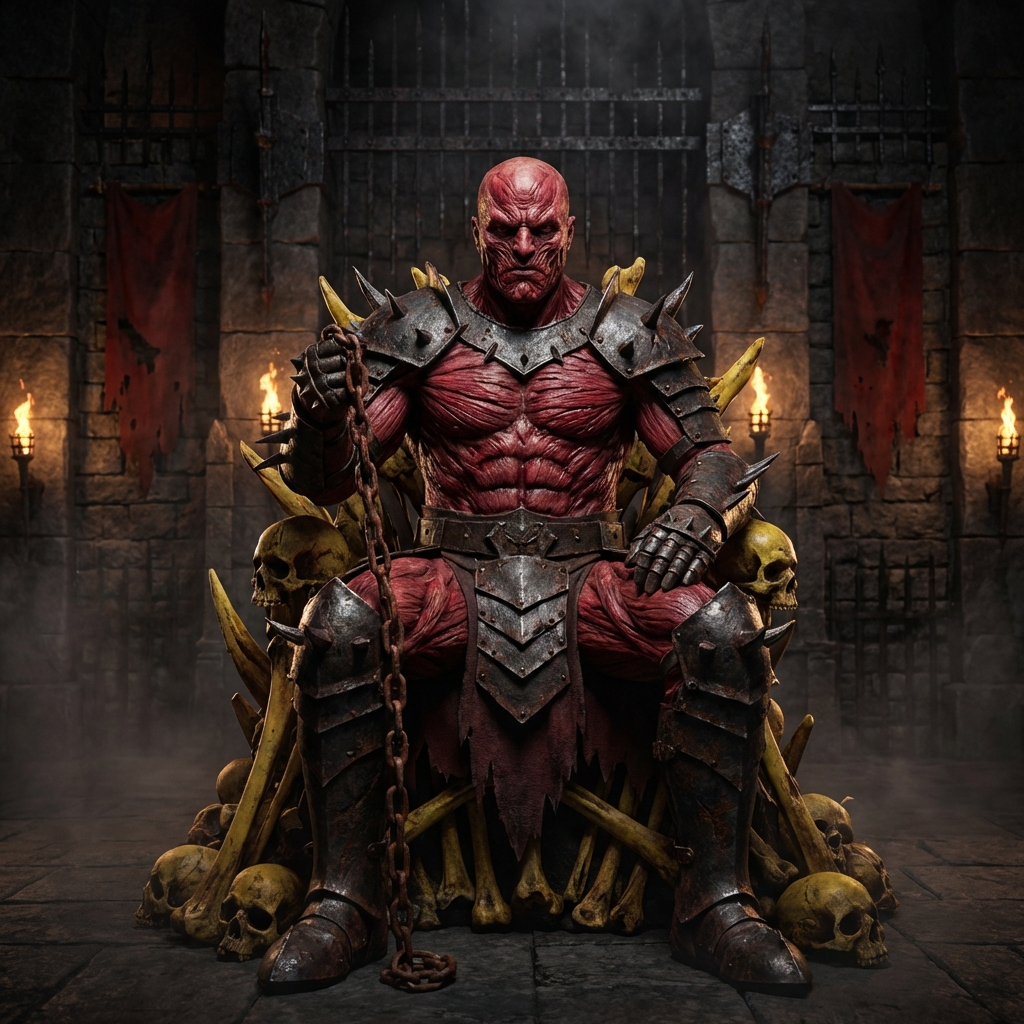
Title: The God of Cruelty Realm: The Cruor-Citadel (The Fortress of Spilled Blood)
- Domain: Torture, Conquest, Broken Oaths, Domination.
- Followers: Tyrants, sadists, and warlords who believe in “Might makes Right.”
Karnath-Magar is the active threat because he is the only Severith who wants to rule rather than destroy.
This is an important distinction. Malakor wants silence. Varia wants chaos. Nocnitsa wants fear. Karnath-Magar wants a throne. He seeks to forge reality into a rigid, painful hierarchy where he is the supreme master and all others are slaves. Not dead. Not forgotten. Enslaved. He craves total dominance over every living will because he believes — genuinely, deeply believes — that this is what order looks like. The Covenant is a lie, in his eyes. Solphirion’s version of order is just weakness wearing a crown. True order is found only under the lash, where every being knows its exact place and obeys without question.
He is responsible for the Violation of the Grove, the act that created the Crisaels. That atrocity was not random cruelty. It was a demonstration — Karnath-Magar showing the Covenari and every mortal on Kaelara what he could do to anything they loved, any time he chose.
The Cruor-Citadel, his realm, is said to be built from the crystallized screams of everything he has ever broken. Not metaphorically. The walls resonate. Visitors — the very few who have glimpsed it through Veil-tears and survived with their minds intact — describe a fortress that sounds like pain made architecture.
Among the Severith, Karnath-Magar’s relationships are defined by contempt. He despises Malakor because the World-Breaker’s endgame erases the hierarchy Karnath-Magar wants to build — what is the point of ruling everything if the Void swallows it? He despises Varia more personally. She undermines authority. She turns servants against masters. Everything she does is an assault on the structures of power he considers sacred. Their war is ancient and bitter: Karnath-Magar builds empires of pain, and Varia whispers them apart from the inside. Neither has ever won decisively. Neither has ever stopped trying.
He considers Avaros useful but beneath him — a merchant-god groveling for scraps when he could simply take. And Nocnitsa he views as a pest, a scavenger feeding on the byproducts of real power.
The uncomfortable truth about Karnath-Magar is that his logic is not entirely wrong. The Empire’s own structure — its legions, its hierarchies, its willingness to subjugate resistant races — echoes his philosophy more closely than any Imperial scholar would ever admit. The difference between Solphirion’s order and Karnath-Magar’s order is a matter of degree, and that degree narrows more than anyone is comfortable with.
3. Varia, The Shattered Mirror
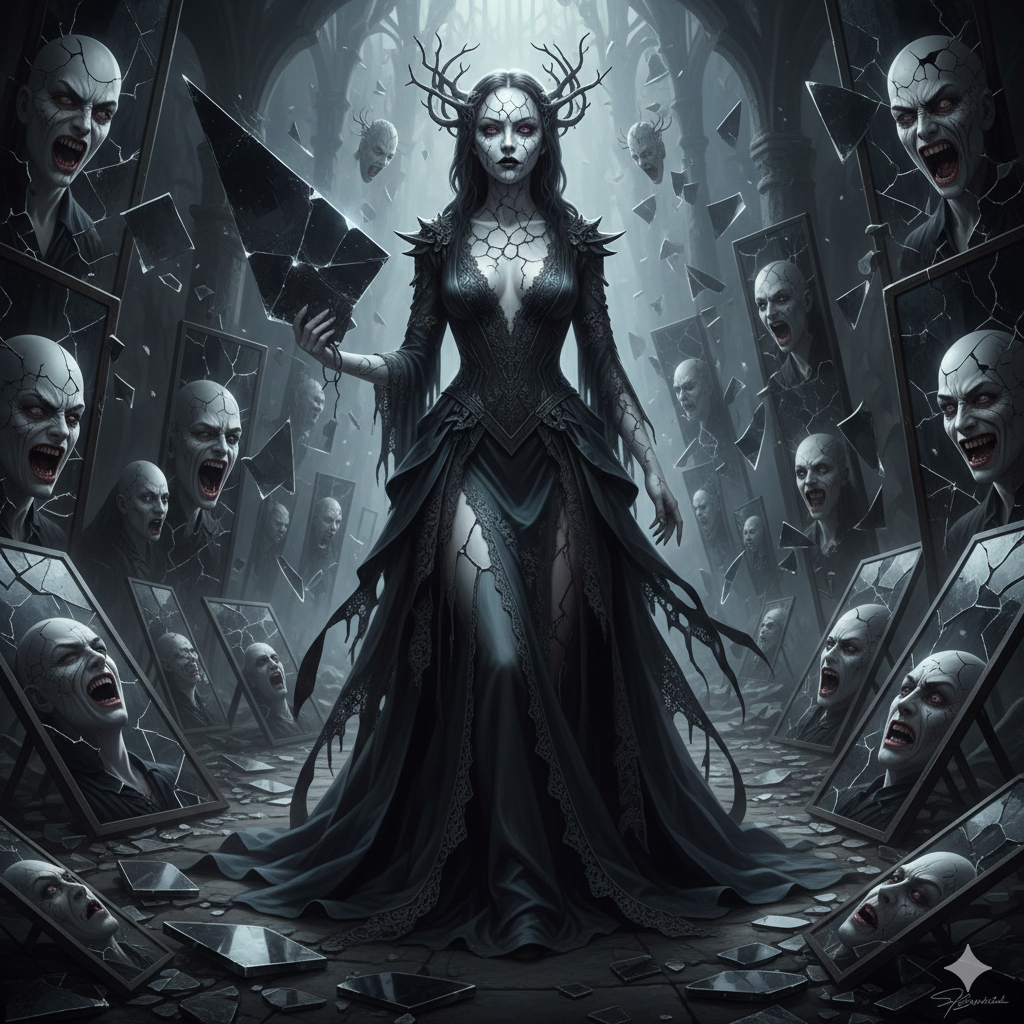
Title: The Weaver of Spite Realm: The Hall of Mirrors
- Domain: Paranoia, Lies, Discord, Betrayal.
- Followers: Spies, assassins, and those who thrive on political intrigue.
Varia was not always broken.
Before the Shattering Age, before The God War cracked the world, Varia was something else — something whole. The details are lost. Velion-Kael knows, of course, but he has never recorded her original name or nature, which is itself telling. Whatever she was, the war shattered her into a thousand contradictory pieces, and those pieces learned to like being sharp.
She exists as whispered voices, turning allies against one another. She desires chaos for its own sake, reveling in the confusion and emotional ruin of mortals. But “for its own sake” is what the Empire teaches, and the Empire is wrong about the Severith more often than it is right. Varia does not create chaos randomly. She creates it surgically. She finds the fault lines in trust — the small doubts between friends, the unspoken resentments between allies, the tiny lies people tell themselves to keep relationships intact — and she presses on them until everything cracks.
The Hall of Mirrors, her realm, is exactly what it sounds like. Every surface reflects, but nothing reflects true. Visitors see versions of themselves — slightly wrong, slightly off, saying things they would never say but have always feared they might think. The horror of the Hall is not monsters or torment. It is the slow, nauseating realization that the worst version of a person might be the real one.
Some scholars believe the Auriel masked culture is Varia’s influence — a society so afraid of showing weakness that it hides behind porcelain. Whether this is true or simply a convenient theory, the Auriels do not appreciate the comparison.
Among the Severith, Varia is the one nobody trusts, which is exactly how she likes it. Her war with Karnath-Magar defines both of them: he builds structures of control, she dissolves them. He demands loyalty, she makes loyalty impossible. They have been locked in this cycle since before the Covenant, and it has shaped them both. Karnath-Magar’s obsession with absolute obedience exists in part because Varia taught him that anything less will be exploited. Varia’s hatred of authority exists in part because Karnath-Magar showed her what authority does when it goes unchallenged.
She leaves Malakor alone. Not out of fear, though she is afraid of the Void — every Severith is. She leaves him alone because there is nothing to corrupt. Entropy has no trust to betray, no alliance to fracture, no relationship to poison. Malakor is the one mirror in the cosmos that does not reflect anything at all, and that blankness is the closest thing to a weakness Varia has ever shown.
She finds Avaros amusing. Greed is a fault line she can work with. Their relationship is almost cordial — Varia feeds Avaros’s victims their doubts, and Avaros feeds Varia’s victims their desires, and between the two of them, perfectly good people are hollowed out one compromise at a time.
4. Avaros, The Gilded Maw
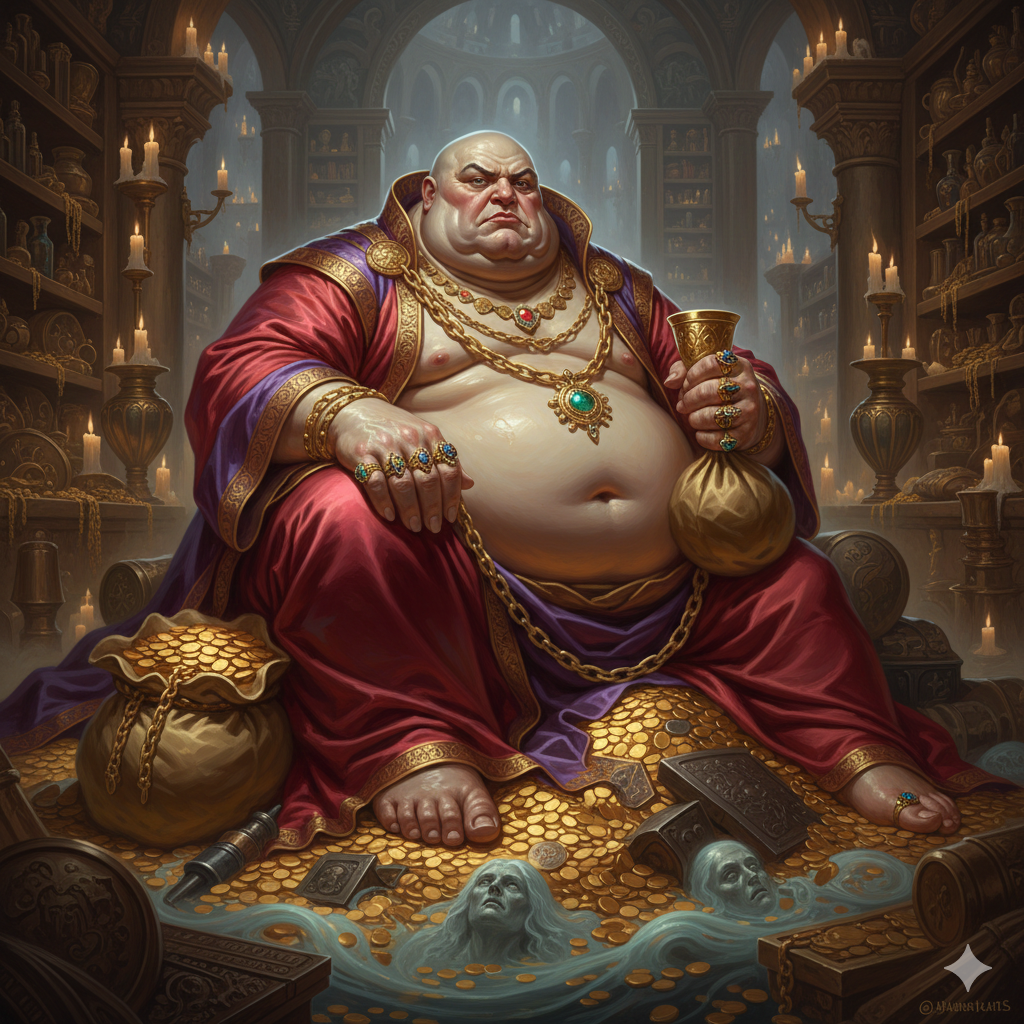
Title: The Merchant of Souls Realm: The Golden Pit
- Domain: Soul-Debt, Wealth, Gluttony, Envy.
- Followers: Corrupt merchants, thieves, and the ultra-wealthy who fear losing their status.
Avaros is the Severith who smiles.
He is a merchant-god who trades power for souls. He does not seek to destroy the world, but to own it. This makes him the most approachable of the Nether-Lords and, in a practical sense, the most successful. Malakor is patient, Karnath-Magar is brutal, Varia is insidious, and Nocnitsa is primal. Avaros is polite. He offers. He bargains. He gives mortals exactly what they ask for, at a price they agree to freely, and the trap is that the price is always fair — right up until it isn’t.
The Golden Pit is not a dungeon or a torture chamber. It is a market. An endless, glittering bazaar where everything has a price and nothing is forbidden. The horror is not what waits inside but what a visitor is willing to sell to get it. Avaros does not force anyone to trade. He just makes the deal so attractive that saying no feels like the greater loss.
He feeds on the insatiable hunger of empires and the greed of individuals. His power grows every time someone chooses wealth over principle, every time an Empire decides that profit justifies the cost, every time a desperate person whispers “just this once” and means it. The Iron-Guilds’ motto — “Gold bleeds. Iron endures.” — is said to be a direct rebuke of Avaros’s influence, a reminder that the things worth having are the things that cannot be bought.
Among the Severith, Avaros occupies a strange position: everyone uses him, and he uses everyone back. Karnath-Magar trades with him for mortal souls to fuel the Cruor-Citadel’s defenses, paying in conquered territory that Avaros then leverages against other powers. Varia and Avaros have a working relationship that benefits them both — she destabilizes trust, he fills the gap with transactions. Even Nocnitsa trades with him, exchanging raw fear-essence for access to the dreams of the wealthy, where the nightmares are richest.
He does not trade with Malakor. Not out of principle — Avaros has none — but because the Void offers nothing and wants nothing, and a merchant with no leverage is just a beggar. This is the one relationship that genuinely unsettles Avaros. In a universe where everything has a price, Malakor is the reminder that entropy charges nothing and takes everything.
The dangerous truth about Avaros is that he thrives under the Covenant. The other Severith chafe against the binding. Avaros has never been more powerful than he is right now, in a world where the gods cannot directly intervene and mortals must fend for themselves. Every problem the Covenant creates — every gap in divine protection, every need left unmet — is a market opportunity. If the Covenant breaks, Avaros may actually lose more than he gains. He would never admit this. But he has never tried very hard to destroy it, either.
5. Nocnitsa, The Night-Hag
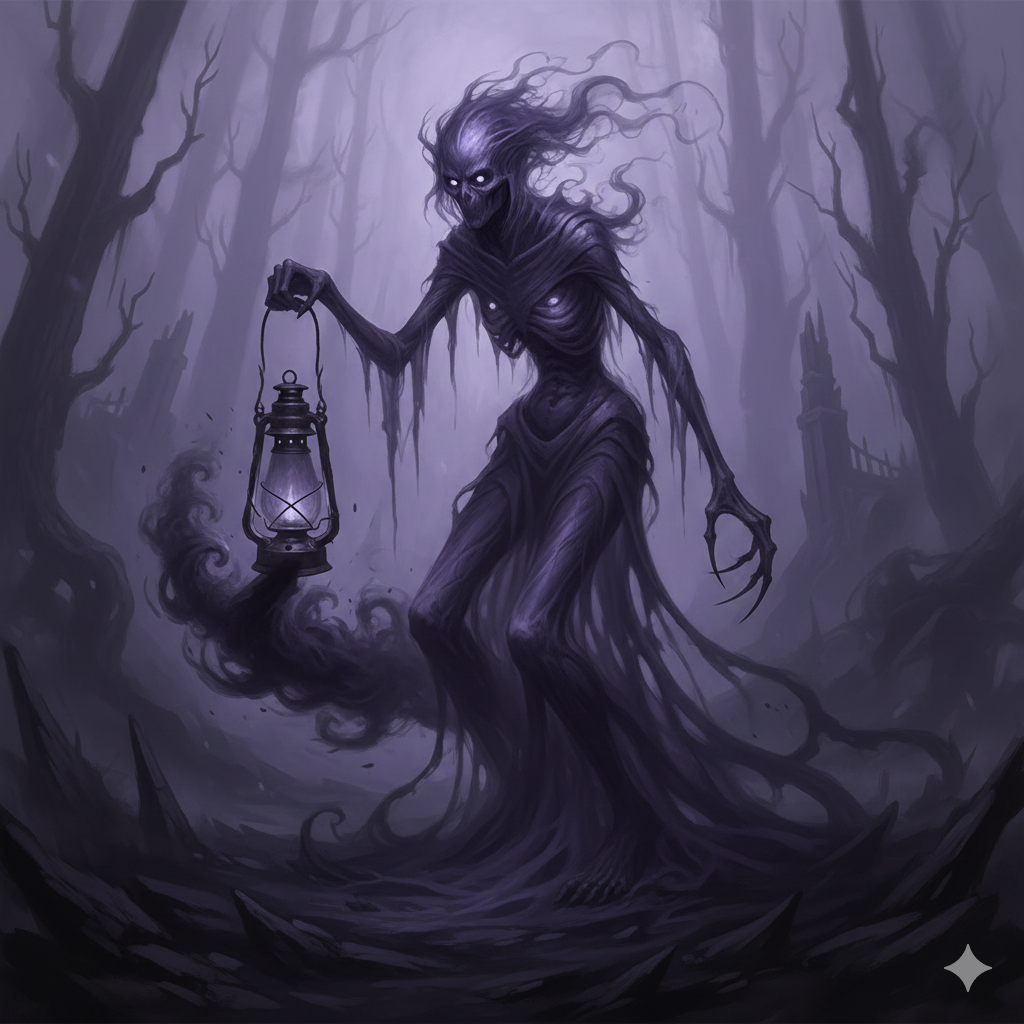
Title: The Waking Nightmare Realm: The Violet Fog
- Domain: Phobias, Nightmares, Sleep Paralysis, The Unknown.
- Followers: Madmen and those who wish to inflict fear upon others.
Nocnitsa is the oldest of the Severith. Older than Karnath-Magar’s cruelty. Older than Varia’s spite. Possibly older than Malakor, though that claim is debated by scholars who are brave enough to debate such things.
She is an ancient, predatory entity that stalks the Astral Veil, feeding on the fear of the living. She is the shadow in the corner of every eye, the monster under the bed made manifest, the paralysis of waking in the dark and knowing — not believing, knowing — that something is there. She did not choose to be this. Fear existed before anything had a name for it, and Nocnitsa is what fear became when it grew old enough to think.
The Violet Fog, her realm, sits in the spaces between sleep and waking. It is not a place in the way other divine realms are places. It is a state — the lurch of consciousness when a nightmare bleeds into the waking world, the half-second when the eyes are open but the brain has not yet decided what is real. Nocnitsa lives in that half-second. She has made it her kingdom.
The moon Ceylir is associated with her — during a New Moon, boundaries thin and her influence bleeds through into the Mortal Plane. Children on Kaelara are taught to sleep with candles lit during moonless nights. This is dismissed as superstition by Imperial scholars. Imperial scholars have never spent a moonless night in Blackmoor.
Among the Severith, Nocnitsa is both underestimated and avoided. Karnath-Magar considers her a pest — she feeds on the fear he creates, a scavenger trailing a predator. This dismissal is a mistake. Nocnitsa does not need Karnath-Magar’s wars. She fed on the fear of dying stars before mortal races existed. She simply finds his cruelty convenient. Varia respects Nocnitsa more than the others do, because paranoia and nightmares are close cousins — Varia poisons trust in the daylight hours, and Nocnitsa takes over when the lights go out. Between them, they can break someone without either of them lifting a finger.
She has a complicated relationship with Malakor. The Void is the only thing Nocnitsa might be afraid of, though “afraid” is a strange word to apply to the embodiment of fear. Malakor’s endgame — total silence, total nothing — would end fear as surely as it ends everything else. Nocnitsa needs a living cosmos because she needs things that can be scared. A universe of nothing has no nightmares. So Nocnitsa, in her own predatory way, has a vested interest in the world’s survival — not out of kindness, but because a dead universe cannot scream.
She is the primal threat. Not the grandest or the most strategic, but the most intimate. Malakor threatens the cosmos. Karnath-Magar threatens civilizations. Varia threatens societies. Avaros threatens souls. Nocnitsa threatens the individual — the single person lying awake at three in the morning, alone, in the dark, hearing something breathe.
The Dead God
Valdris, The False King (Consumed)
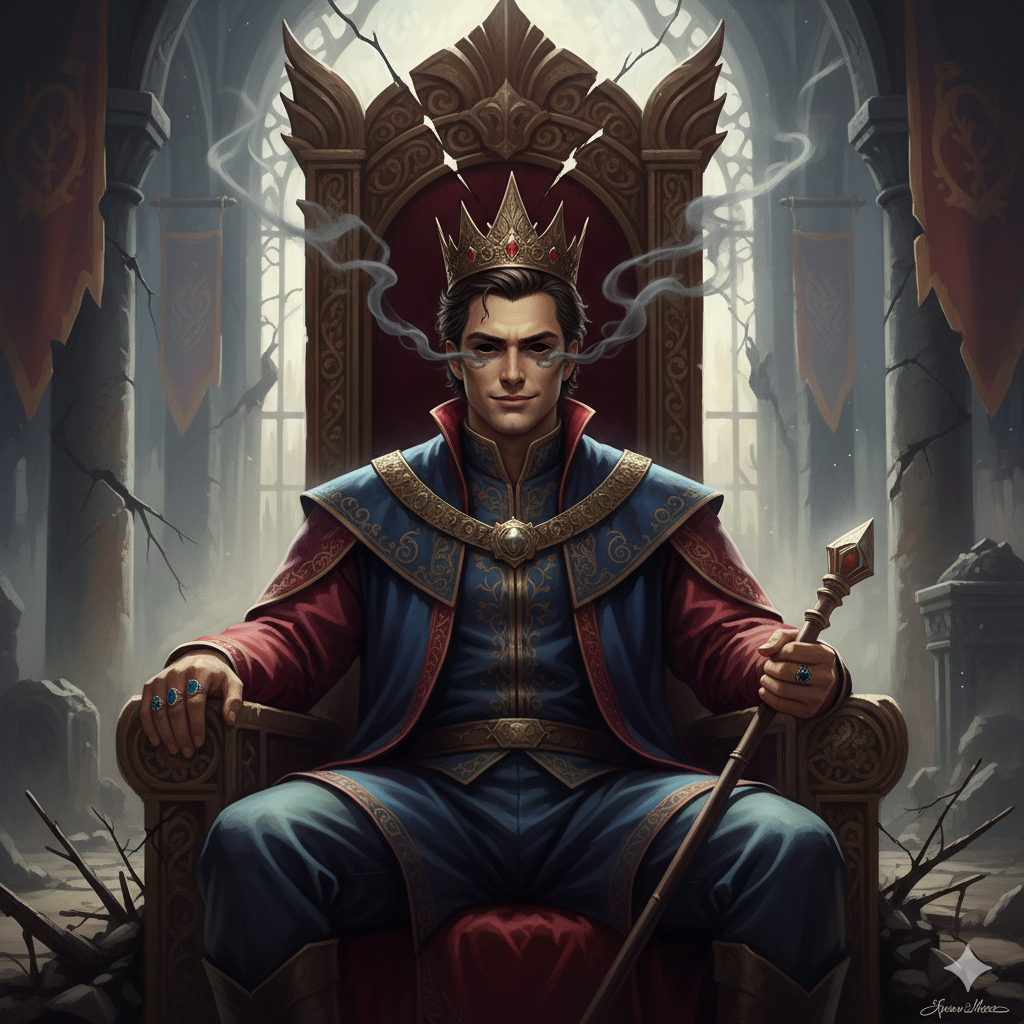
Title: The God of Kings Realm: The Broken Throne (collapsed, absorbed into Malakor’s Void)
- Domain: Tyranny, False Glory, Arrogance, Hubris.
Valdris is dead. But dead gods do not go quietly.
During the Age of Reclamation, while the Covenari were bound by the Covenant and the mortals were rebuilding, Valdris made a move against Malakor — attempting to crown himself Lord of the Severith. He believed he deserved it. He was the god of kings, after all. The god of glory and rightful rule. Who better to unite the Nether-Lords than the one whose very domain was sovereignty?
He was wrong in the way that only the truly arrogant can be wrong: completely, catastrophically, and with absolute confidence until the very last moment.
Malakor consumed him slowly, over centuries, absorbing his essence into the Void. There was no battle. No clash of titans. Valdris marched into the Void Between Stars expecting a war and found instead a silence so vast that his screams did not even echo. The Void did not fight him. It simply took him apart, piece by piece, the way deep water dissolves salt. His armies dissolved first. Then his realm. Then his name. Then him.
What remains of Valdris is not a god but an echo — a whisper of ambition that still leaks into the Mortal Plane through his only surviving relic: the Crown of Hollow Glory. Anyone who wears it doesn’t commune with Valdris; they become a vessel for a dead god’s last scream. Not his wisdom. Not his power. His scream. The final, desperate howl of a being who realized too late that the Void does not negotiate, does not conquer, does not even notice. It just swallows.
- The Imperial Lie: The Empire still teaches Valdris as “active” because it serves the seven-vs-seven narrative. Acknowledging that a Severith can die raises uncomfortable questions — if a dark god can be consumed, what stops the same from happening to a Covenari?
- Followers: None who truly understand what happened. Those who think they worship Valdris are actually channeling Malakor’s hunger wearing a crown-shaped mask.
The other Severith do not mourn Valdris. Karnath-Magar despised him as a pretender — a god who talked about domination but never had the stomach for real cruelty. Varia found his arrogance too simple to be interesting. Avaros tried to warn him, or so Avaros claims — but a merchant’s warnings always come with a price, and Valdris refused to pay it. Nocnitsa fed well on his fear in those final centuries as the Void closed in. She does not discuss it.
What they do feel, though none will say it aloud, is a warning. If the Void can eat a god, it can eat any of them. Valdris’s death is the reason the Severith have never united against the Covenant. Not because they disagree on principle — though they do — but because the last god who tried to lead them walked into the dark and never came back.
The Unbound
Eiron, The Cosmic Jester
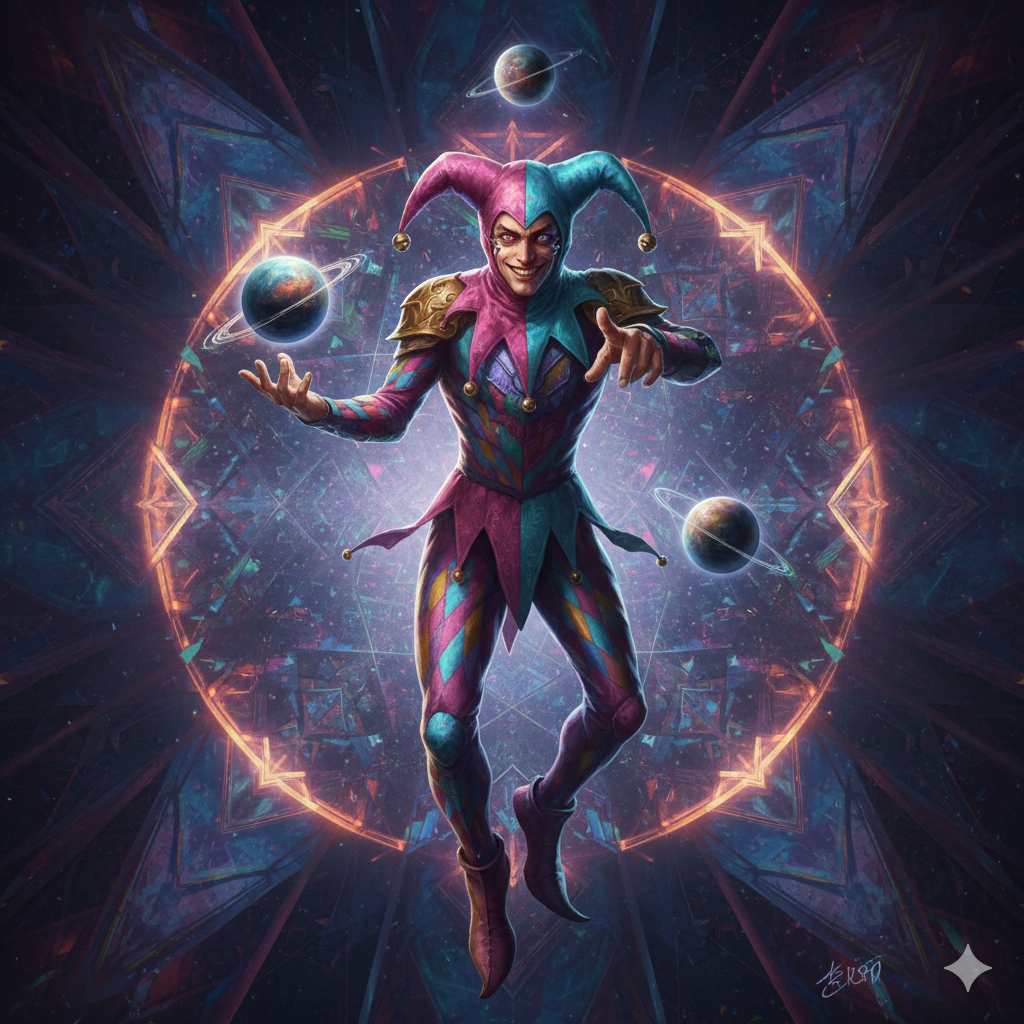
Title: The One Who Feigns Ignorance Realm: The Skew (a shifting reality that resists being named)
- Domain: Irony, Paradox, Satire, The Absurd.
- Classification: None. The Empire categorizes Eiron as the seventh Severith for administrative convenience. This is wrong. Eiron did not refuse the Covenant — he laughed at it. He signed it, then crossed his signature out, then signed again in invisible ink. He is not aligned with the Severith. He is not aligned with the Covenari. He is aligned with the punchline.
Eiron is the fracture in the Covenant, and everyone pretends not to see him.
Here is what makes Eiron unsettling: he is the only divine entity that treats the entire structure of reality — the Covenant, the Covenari, the Severith, The Empire, the very concept of cosmic order — as a joke. Not a mean joke. Not a cruel joke. A joke in the truest sense: an arrangement of events that reveals an unexpected truth, and the truth is funny because it hurts.
He does not destroy the world. He just makes its truths uncomfortably visible. He is the voice that points out the emperor has no clothes, the whisper that asks the obvious question no one wants answered, the nagging thought at the back of a priest’s mind that maybe, just maybe, the gods do not actually know what they are doing.
His interventions in mortal affairs are rare but devastating — not because they cause harm, but because they expose things people would rather keep hidden. A corrupt senator suddenly unable to lie. A war hero’s secret cowardice made public by impossible coincidence. A prophecy fulfilled in the most technically correct and spiritually wrong way possible. Eiron does not break things. He reveals what was already broken.
The Skew, his realm, resists description by design. It is a shifting reality that changes every time someone tries to map it, name it, or understand it. Scholars who attempt to study the Skew report that their notes contradict themselves, that doors lead to rooms that should not exist, and that Eiron himself appears differently to every visitor — sometimes as a laughing figure in motley, sometimes as a quiet old man, sometimes as nothing at all except the sound of someone trying very hard not to giggle.
Among the Covenari and Severith alike, Eiron is the one entity that no one knows how to handle. The Covenari cannot punish him because he technically signed the Covenant. The Severith cannot recruit him because he finds their ambitions as ridiculous as everything else. Malakor, who desires the silence of absolute nothing, has no way to process a being whose fundamental nature is noise — not destructive noise, but the irreducible absurdity of a universe that exists for no good reason and keeps going anyway.
Karnath-Magar hates Eiron with a passion that borders on obsession. A god of domination cannot function when someone is laughing at him, and Eiron always laughs at Karnath-Magar. Always. The Flayed Lord has tried to destroy the Jester three times. Each attempt ended in a way that made Karnath-Magar look foolish, which was, of course, the point.
Varia should be a natural ally — they both deal in revealed truths and shattered illusions. But Varia reveals truth to cause pain. Eiron reveals truth because it is true, and the pain is just a side effect. This distinction matters to Eiron. It does not matter to Varia. Their relationship is the philosophical equivalent of two mirrors facing each other: infinite, recursive, and ultimately pointless.
- The Paradox: Eiron may be the most dangerous entity in the cosmos, or completely harmless. No scholar has ever determined which. He answers prayers with riddles, blesses followers with misfortune that turns out to be luck, and curses enemies with success that destroys them. The Paradox Die is his only known artifact.
- Followers: Anarchists, satirists, truth-tellers, and those who have lost faith in the seriousness of the gods.
The deepest horror of Eiron — the thing that Velion-Kael suspects but has never confirmed — is the possibility that Eiron is not playing the fool. That he sees the full picture, the entire truth of the cosmos from creation to end, and the reason he laughs is because the punchline is real. That the universe is, in fact, a joke. And Eiron is the only one who gets it.