The Covenari
The Covenari (also known as the Seven Covenanted) are the divine entities who swore the Heavens’ Covenant to preserve reality during the Shattering Age. They bound themselves to specific laws to prevent the cosmos from unraveling, sacrificing their ability to directly intervene in the Mortal Plane in exchange for stability.
They are worshipped by the Empire of Eldara and most civilized races of Kaelara.
But worship is not the same as understanding. The Covenari are not a family. They are seven powerful beings chained to the same oath, each pulling in a different direction, held together by the memory of what happened the last time they let go. Some of them respect each other. Some merely tolerate. And at least two have not spoken since the Covenant was signed.
1. Solphirion, The Arbiter
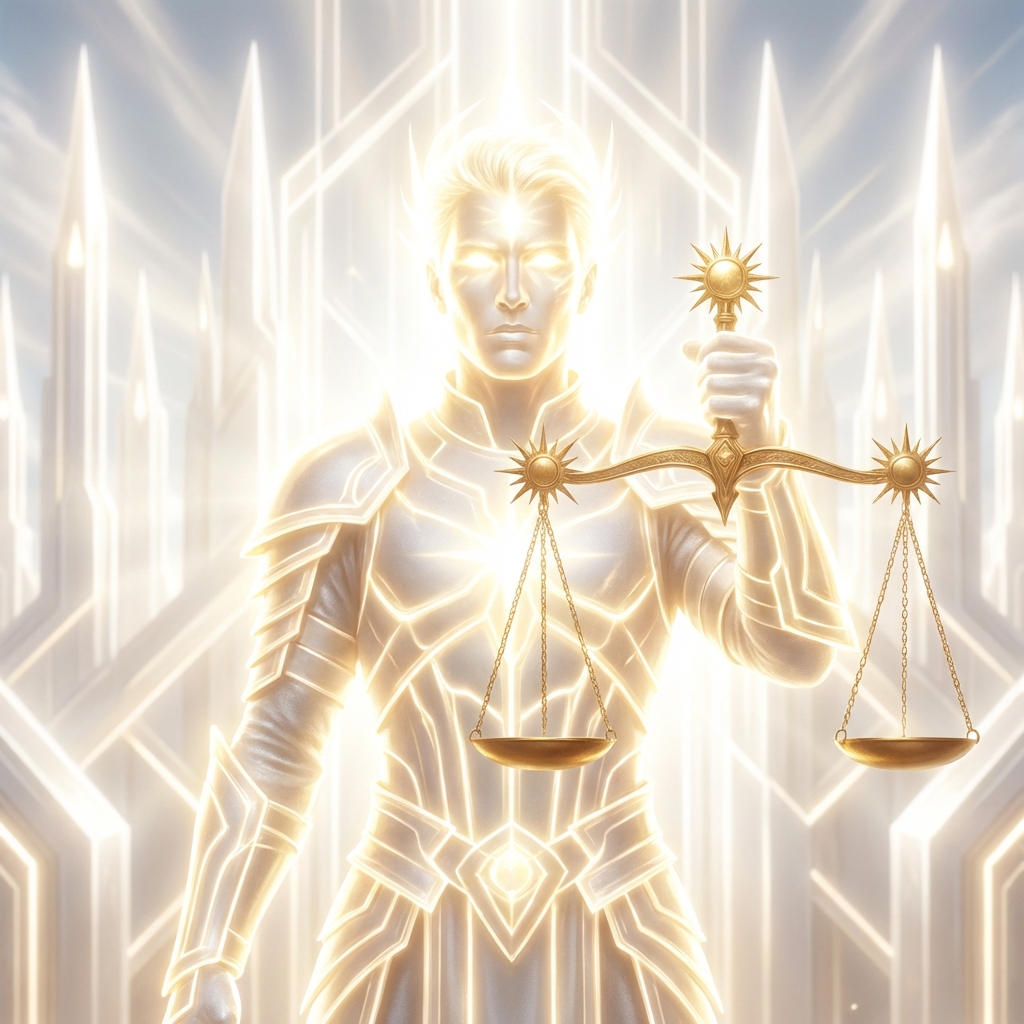
“Order is not the absence of chaos, but the balance of it.”
- Domain: Balance, Sun, Justice, Order.
- Symbol: A golden scale tipped with a sunburst.
- Patronage: The Auriels (Golden Elves) and the Imperial Justiciars.
Solphirion was never the strongest of the gods. He was the most tired.
By the end of The God War, when the Mortal Plane was cracking apart and the Leylines bled raw magic into the sky, Solphirion looked at what they had done and felt something none of the others could name. Not rage. Not grief. Exhaustion. The bone-deep kind that comes from watching the same argument destroy everything, over and over, with no one willing to stop.
So he stopped it himself. During the Celestial Accordance, when Nythra and Ceylir aligned with the Infinite Spire, Solphirion dissolved his physical form to create the Astral Veil — the barrier between the Mortal Plane and the Void — and inscribed the Covenant upon it. He did not ask for volunteers. He told the others what he was doing, and then he did it, and the force of his sacrifice left them no choice but to sign or be swept away.
That is the part the temples leave out. The Covenant was not a negotiation. It was an ultimatum from a god who had decided that dying for order was better than living in chaos.
What remains of Solphirion is the Warden of Echoes — not a ghost, not a god, but a shard of divine will fused into the barrier he created. He guards the physical Covenant in the Obsidian Marshes, trapped between protecting it and wanting it destroyed so he can finally rest. Pilgrims who reach him do not find a serene arbiter. They find someone who is still angry that he had to be the one.
The other Covenari do not talk about Solphirion often. Lunarae tends the Veil he became. Othea calls his sacrifice unnecessary, the act of a god who confused control for wisdom. Ignifer respects the sheer stubbornness of it, even if he thinks Solphirion was a fool. And Velion-Kael, who records everything, has never once written down what Solphirion said to each of them before he dissolved. That silence says more than any scripture.
Among mortals, Solphirion is the central figure of the Imperial Pantheon. His light represents the “Law” of the universe. But his priests carry a quiet unease they never voice: their god is not watching from above. He is buried in the structure of reality itself, holding it together with what is left of his will. And that will is fraying.
2. Lunarae, The Weaver
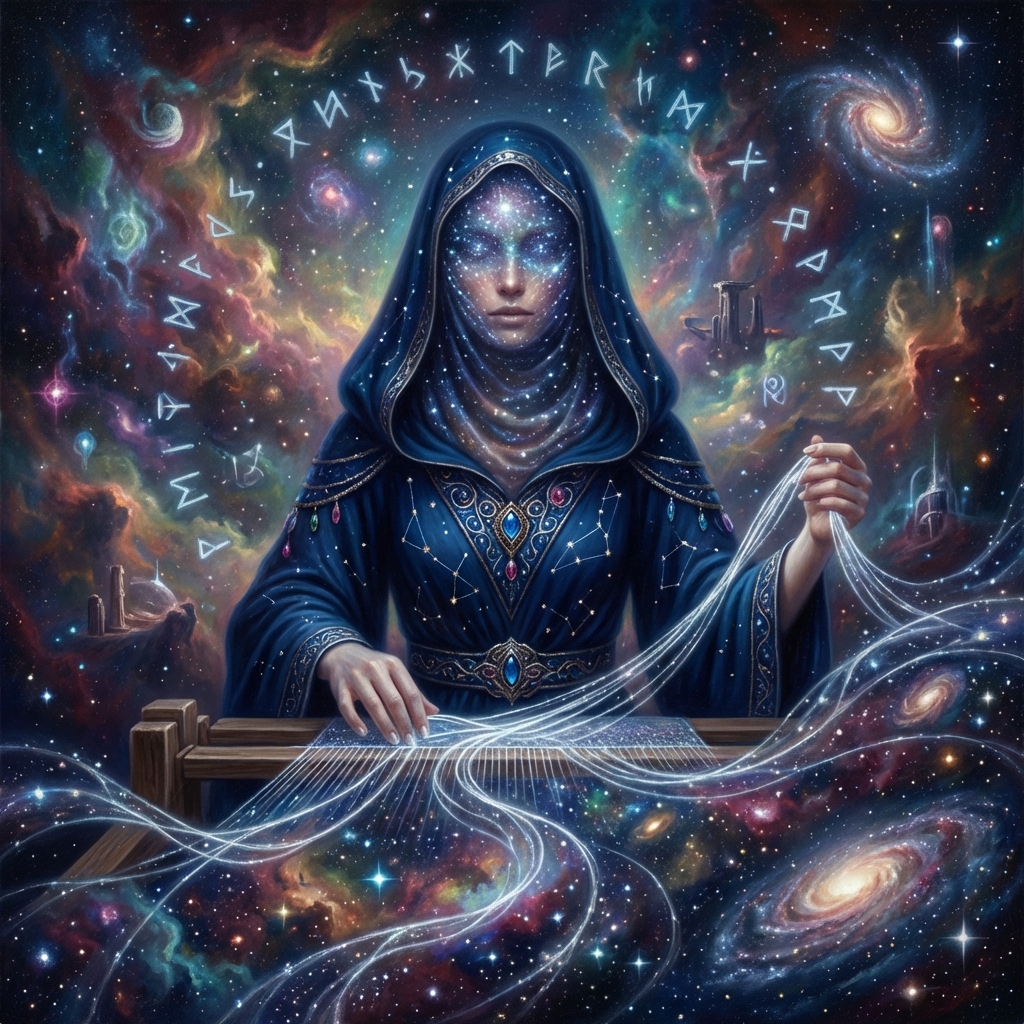
“The threads of fate are not cut, they are re-woven.”
- Domain: Magic, Moon, Mystery, Fate.
- Symbol: A silver crescent interwoven with thread.
- Patronage: Revered by Umbrics (Mystical Mortals), scholars, and arcanists.
Lunarae is the quietest of the Covenari, and the most burdened.
She is the Keeper of the Astral Veil. While Solphirion created the barrier, Lunarae is the one who maintains it — weaving the Leylines that allow magic to flow through reality without tearing it apart. Every spell cast on Kaelara passes through her work. Every arcanist who draws power through the Veil is, whether they know it or not, pulling on threads she placed.
She is often depicted as a veiled woman holding a loom of starlight, and that image is closer to truth than most divine art. Lunarae works constantly. She has not rested since the Covenant was signed. The Veil frays, and she mends it. Micro-tears appear where mortals push magic too hard, and she weaves them shut. The moon Nythra — believed to be her physical heart — still bears the fracture lines from when Malakor struck it in 1A 487, and some scholars argue that blow wounded not just a moon but the goddess herself. Lunarae has never confirmed or denied this. She confirms very little.
Her relationship with Solphirion was complicated even before his sacrifice. They were the two who understood each other best — both saw that the war would end everything if left unchecked. But Solphirion acted without consulting her, and the Veil he created landed squarely in her lap to maintain. There is a prayer among Umbric scholars: “Lunarae weaves what Solphirion broke.” It is not meant as blasphemy, but it is not wrong either.
She clashes most often with Aenior. Change and fate are natural enemies — Aenior tears apart what Lunarae carefully constructs, and she considers his chaos reckless. He considers her control suffocating. Their disagreements ripple into the mortal world as storms that disrupt Leylines, wild magic surges that sweep coastal cities, and entire divination traditions that simply stop working for weeks at a time.
Of all the Covenari, Lunarae is the one most aware that the Covenant is weakening. She can feel it in the threads. She knows exactly how many years the Veil has left if nothing changes, and she has told no one — not even Velion-Kael, who suspects she is hiding something and resents her for it.
Mortals experience Lunarae as the sudden clarity of a spell clicking into place, the chill of a prophecy settling into the bones, or the sense that the world has a pattern just beyond the edge of sight. Her faithful do not pray loudly. They sit in moonlit rooms and listen.
3. Othea, The Warden
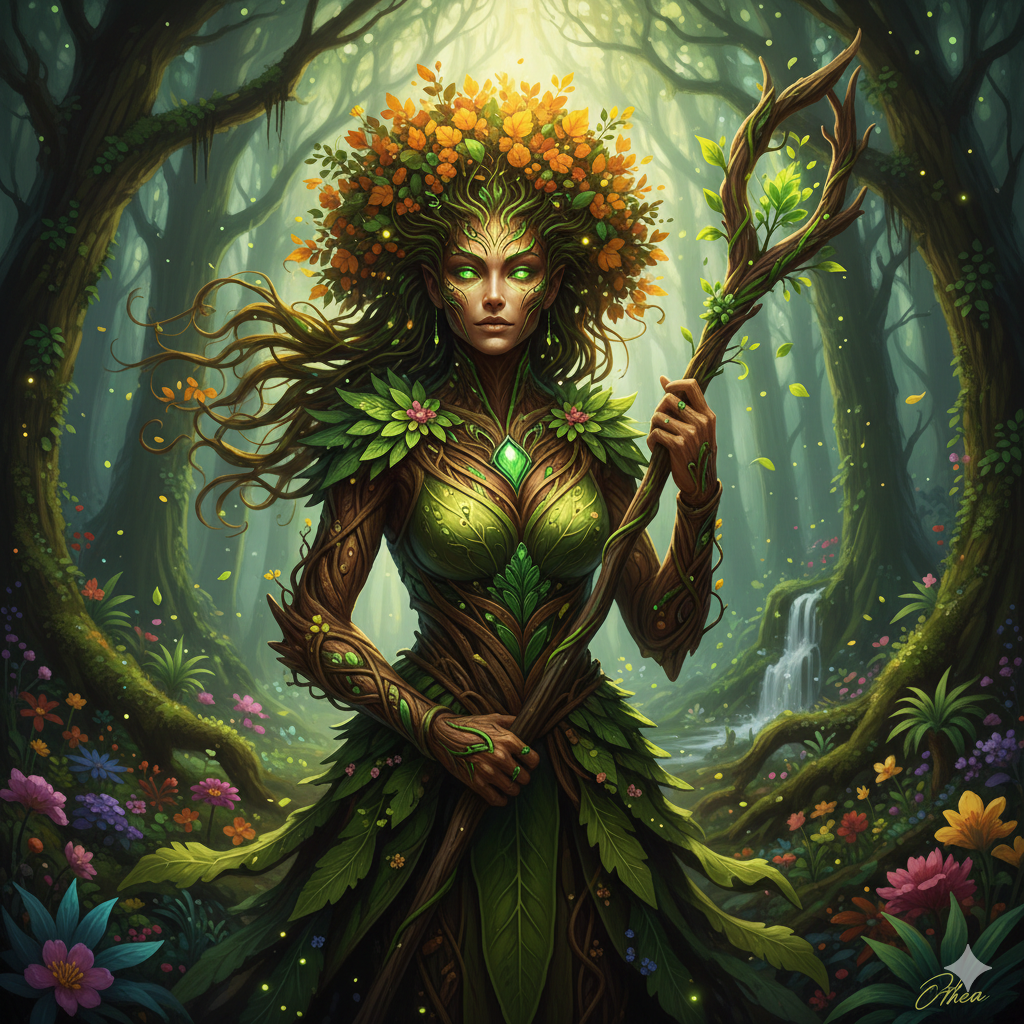
“The root endures long after the stone creates dust.”
- Domain: Nature, Life, Wilds, Decay.
- Symbol: An antlered helm entwined with roots.
- Patronage: Patron of the Sylvaels (Forest Elves) and Tharuns (Druids).
Othea is the oldest thing that still has a name.
The Green Mother. Her breath is the wind and her blood is the sap of the world. She existed before the Covenant and will endure long after it is gone. She represents the cycle of life that even gods must respect — growth and decay, bloom and rot, the forest fire that clears the way for new saplings. She signed the Covenant not because she agreed with Solphirion, but because the natural order demanded it. The God War was unnatural. It had to stop. Her reasons ended there.
This is what makes Othea difficult for the other Covenari: she does not care about their project. The Covenant, The Empire, the careful balance of divine politics — none of it matters to her the way the turning of seasons matters. She thinks Solphirion’s sacrifice was noble but foolish, the act of a god who mistook rigid control for the patient wisdom of letting things grow and die in their own time. She told him so before he dissolved. He did it anyway.
Othea’s relationship with Ignifer is the oldest tension among the Covenari. Fire consumes what nature builds. Industry carves up what the wilds create. Ignifer sees forests as fuel; Othea sees forges as wounds. They have not spoken directly since the second age, communicating only through the slow language of their domains — a volcanic eruption answered by a century of reclaiming growth, a wildfire followed by a vein of ore gone cold. Their followers mirror this conflict. Tharuns and Dunthar do not hate each other, but they will never fully trust each other either.
Yet Othea holds a strange respect for Oroth. Stone and root are different expressions of the same patience. Mountains do not hurry. Neither do old-growth forests. The two of them share the longest silences in the pantheon, and those silences are comfortable.
Mortals feel Othea in the ache of a long winter finally breaking, in the smell of wet earth after rain, in the unsettling beauty of watching a dead tree feed a hundred living things. Her faithful do not build temples. They tend groves. And when a grove dies, they do not mourn — they watch what grows in its place.
4. Aenior, The Tide
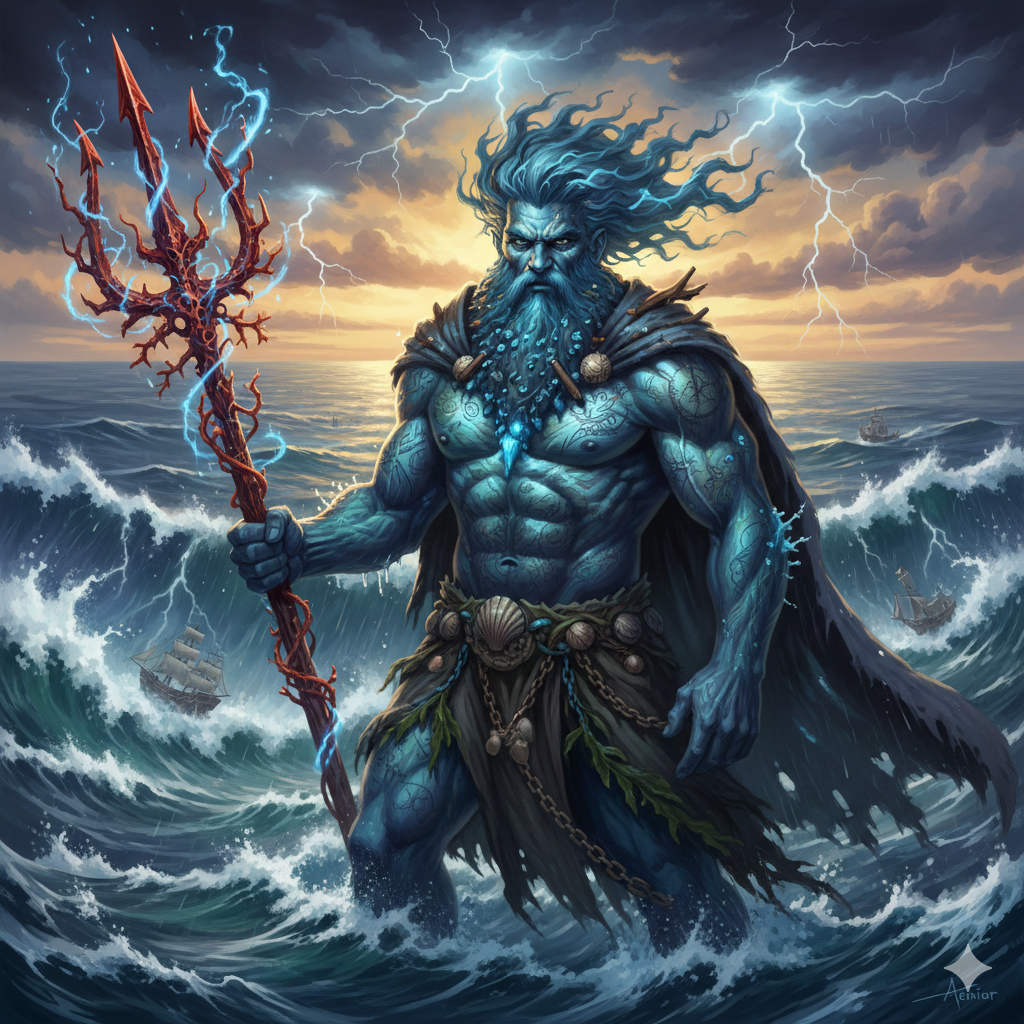
“Change is the only constant.”
- Domain: Sea, Storms, Change, Travel.
- Symbol: A breaking wave within a compass.
- Patronage: Patron of the Tiraels (Ocean Elves) and sailors. Also worshipped by the Ashveils in his desert aspect as “The Scorching Wind” — the god of change, adaptation, and scouring heat. This dual worship is a source of theological tension between the coastal and desert faithful.
Aenior is the god who almost did not sign.
Not out of malice. Not out of pride. He simply could not understand why anyone would want to stop things from changing. The God War was terrible, yes. But it was also motion, energy, the raw churn of the cosmos remaking itself. To Aenior, the Covenant felt like death — not the dramatic kind, but the slow suffocation of a world locked in amber. He signed because Solphirion forced his hand, and because even Aenior could see that the Mortal Plane would not survive another century of divine war. But he has never been comfortable with it.
This makes him the most unpredictable of the Covenari. The others chose their constraints and settled into them. Aenior strains against his constantly. He is the chaotic force that Solphirion sought to balance — the tidal pull against every structure, every fixed point, every law that tries to hold the world still. He blesses voyages one day and crushes fleets the next, not out of cruelty but because the sea does not owe anyone a calm crossing.
The Ashveils know a different Aenior. To them he is not the sea-god but the hot wind that reshapes the dunes and tests the worthy. The Scorching Wind. The one who strips away everything that is not essential and leaves only what can survive. This dual worship is genuine — Aenior is both the ocean and the desert wind, both the storm and the drought, because he is not a god of water. He is a god of change. Water and sand are just the shapes change takes.
Among the Covenari, Aenior clashes most openly with Lunarae. She weaves patterns; he unravels them. She builds careful structures of fate and Leyline; he sends storms that rip through her work like a child kicking over a sandcastle. Lunarae considers him reckless. Aenior considers her afraid. They are probably both right.
His relationship with Ignifer is warmer. Fire and storm share an appetite for destruction that leads to renewal. Aenior and Ignifer understand each other in the way that two forces of nature can: not through words, but through the shared knowledge that sometimes things need to burn or drown before they can grow back stronger. Sailors and smiths drink together for a reason.
Mortals feel Aenior in the lurch of a ship cresting a wave, in the gust of wind that changes a journey’s direction, in the restless itch that makes someone leave a comfortable life for something unknown. His temples are built on coastlines and always face the open water. The Ashveil shrines sit on the highest dunes, where the wind never stops.
5. Ignifer, The Soulforge
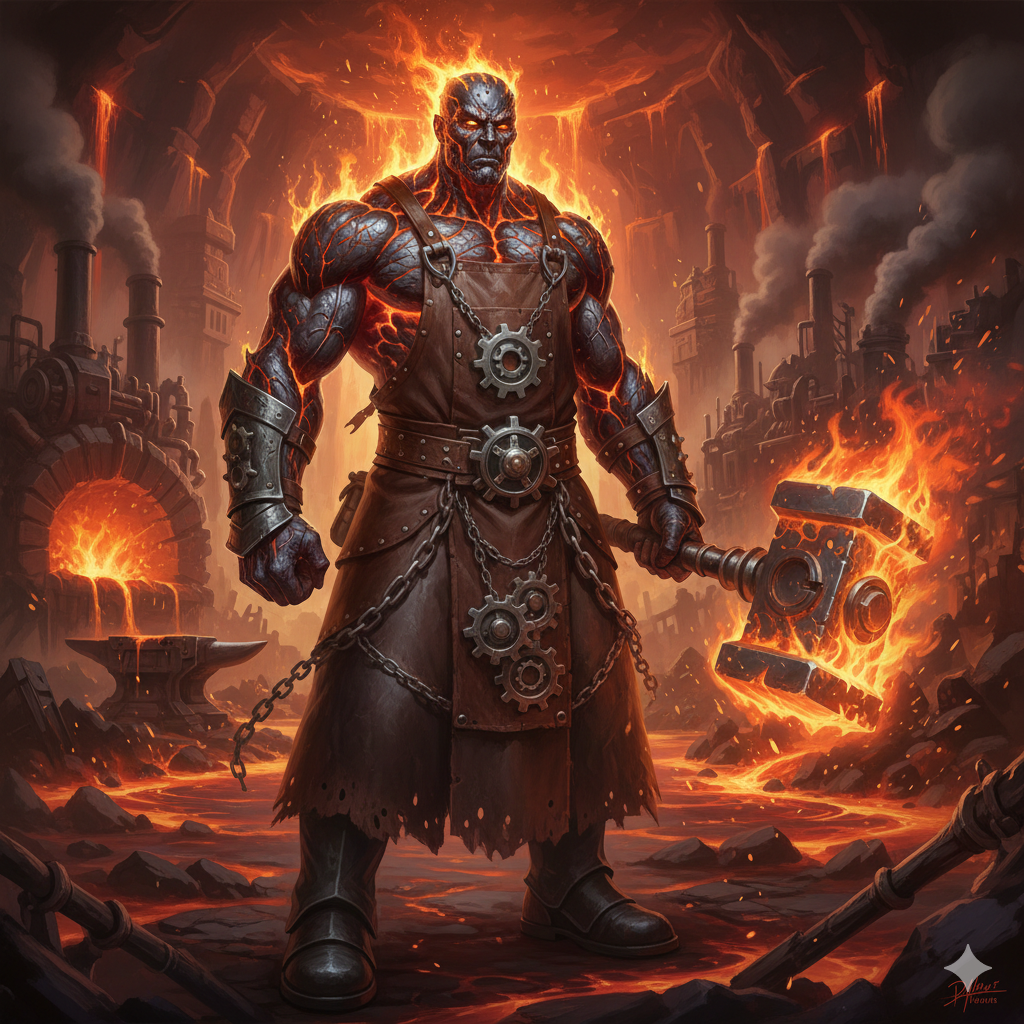
“To forge the new, one must burn the old.”
- Domain: Fire, Craft, Ambition, Volcanism.
- Symbol: A hammer striking a burning spark.
- Patronage: Creator of the Dunthar (of Valkora) and Emberkins.
Ignifer does not do patience.
He is the Fire-Bringer, the god who stole the primordial flame from the Void to forge the first weapons of The God War. That myth defines him completely. While the other gods debated what to do about the growing darkness, Ignifer walked into it, took what he needed, and came back burning. He has never seen a problem he could not solve by hitting it harder, hotter, and with better tools.
This makes him the most straightforward of the Covenari and also the most dangerous. Ignifer embodies the duality of fire: destructive rage and creative industry. He is the god of the forge and the god of the wildfire. The volcano that buries a city and the kiln that fires the bricks to build a new one. He does not see contradiction in this. Fire does not apologize for what it consumes. It just makes something new from the ash.
The planet Kyrris — the Red Ember — is said to be his forge-world, and astronomers have observed massive explosions on its surface that seem to follow no natural pattern. Whether Ignifer is actually working up there or whether the planet simply resonates with his nature, no one can say for certain.
Among the Covenari, Ignifer respected Solphirion more than he will ever admit. Not for the Covenant itself — Ignifer thinks laws are just tools, and tools wear out. But for the sheer audacity of dissolving oneself to make a point. That is the kind of commitment Ignifer understands. He would have done it differently, of course. Louder. With more fire. But he respects the craft of it.
His feud with Othea runs deep. She sees his forges as scars on the world. He sees her forests as raw material waiting to be shaped. Neither is wrong, and neither will bend. Their conflict is the oldest argument in creation: does the world exist to be preserved, or to be made into something better? Ignifer will always answer “better.” Othea will always answer “it already was.”
He gets along with Aenior because storms and fire share the same restless hunger. He tolerates Oroth because stone is the foundation every forge needs, even if Oroth’s stubbornness drives him up the wall. And he ignores Velion-Kael entirely, because what good is writing things down when there is something to build?
Mortals feel Ignifer in the heat of a forge at full blast, in the ambition that keeps a craftsman working through the night, in the dangerous thrill of watching lava reshape a mountainside. His worship is loud, physical, and hot. Temples to Ignifer are workshops first and sacred spaces second. The Dunthar do not pray — they hammer. Each strike is a hymn.
6. Oroth, The Anchor
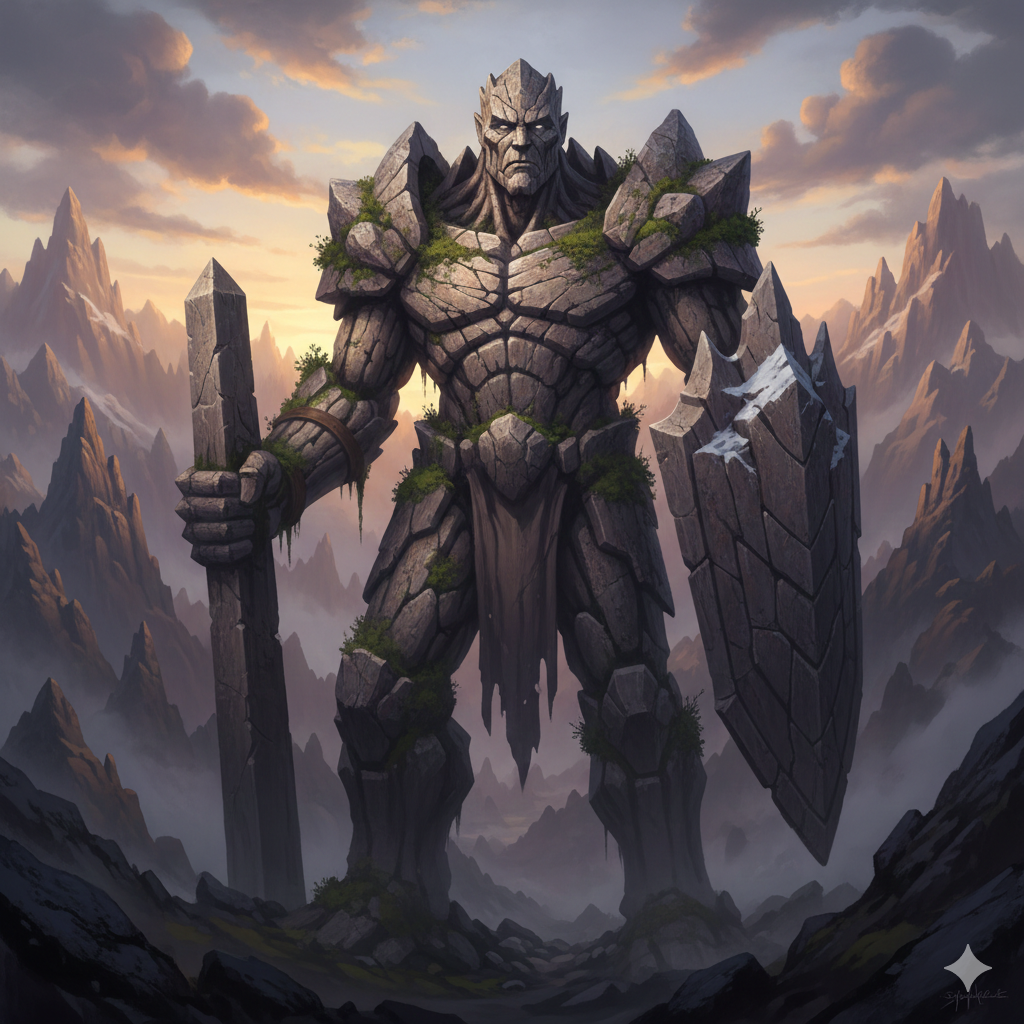
“Stand firm.”
- Domain: Earth, Stone, Protection, Endurance.
- Symbol: A mountain peak or a stone shield.
- Patronage: Patron of the Duraliths (Craggy Beasts).
Oroth says less than any other god. His quote is two words. That tells the whole story.
The Unyielding Foundation. When the world shattered during The God War, myths say Oroth literally held the continents of Kaelara together with his physical strength — not through clever magic or divine strategy, but by planting himself in the fracture and refusing to move. The other gods fought with swords and storms and cosmic fire. Oroth fought by standing still. He won because the world broke around him and he did not.
This is both his greatest strength and the thing that makes the other Covenari quietly worried. Oroth does not change. Ever. He signed the Covenant because protecting reality was the right thing to do, and he has not questioned that decision once in four ages. He does not adapt, he does not reconsider, he does not grow. He endures. In a cosmos where the Covenant is weakening and the other gods are calculating and worrying and scheming, Oroth will be standing in exactly the same place, doing exactly the same thing, until the stars go out.
He represents defense, stubbornness, and unshakeable loyalty. The kind of loyalty that does not ask questions. The kind that does not need to.
Oroth shares a quiet kinship with Othea. Root and stone. Patient things that measure time in millennia, not moments. They do not speak often — Oroth does not speak often to anyone — but there is an understanding between them that runs deeper than words. The mountains and the forests have been neighbors since the world began.
His relationship with Aenior is friction incarnate. Change and stone are natural enemies. The sea erodes the cliff. The storm batters the mountain. Aenior pushes; Oroth holds. Neither gives ground. This is not hatred — Oroth does not hate. It is simply the way things are. Water moves. Rock does not. The argument is geological. It has been going on for a very long time.
Ignifer tests his patience in a different way. Fire and ambition constantly try to reshape what Oroth has settled. Where Aenior’s chaos is natural, Ignifer’s is deliberate — the forge-god is always trying to break stone open to find what is inside, to crack mountains for ore, to reshape the foundations that Oroth considers sacred. Oroth tolerates this because even he recognizes that some stone must be quarried. But there is a line, and Ignifer sometimes crosses it.
Mortals experience Oroth in the steadiness of bedrock under their feet, in the comfort of walls that will not fall, in the stubborn refusal to give up when everything says to run. His faithful are few but immovable. The Duraliths do not build temples to Oroth. They live inside him. The mountains are his body. The caverns are his ribs. To dwell in stone is to dwell in the god.
7. Velion-Kael, The Chronicler
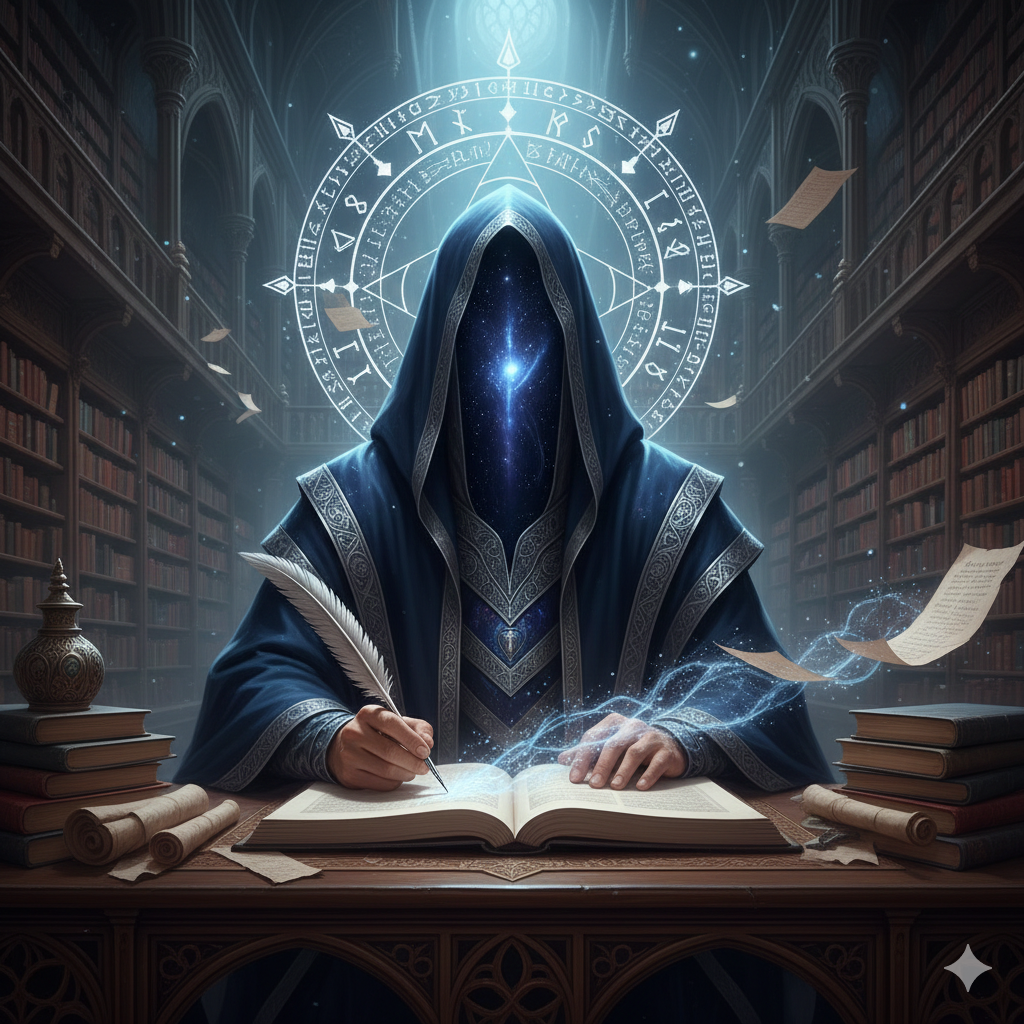
“To forget is to repeat.”
- Domain: Knowledge, Truth, History, Memory.
- Symbol: An infinite scroll or an eye within a geometric shape.
- Patronage: Worshipped by scholars, mages, and those who seek the “Absolute Truth” of the Covenant.
Velion-Kael knows everything, and it is killing him.
The Passive Observer. He records every event in the cosmos but is forbidden by his own nature from interfering. Not by the Covenant — the Covenant binds all the Covenari equally. Velion-Kael is bound by something older: the fundamental law that the one who records history cannot shape it. The moment he acts on what he knows, the record becomes corrupted. Truth becomes agenda. Memory becomes propaganda. So he watches. And he writes. And he says nothing.
He knows the true reason the Shattering occurred, a secret he guards eternally. He knows what Solphirion said to each of the Covenari before dissolving. He knows exactly when the Covenant will fail, because Lunarae’s careful silence about the Veil’s timeline is not careful enough to fool someone who has been reading the patterns of reality since before mortals existed. He knows which of the Severith will move first, and what they will do, and what it will cost.
And he cannot say a word.
This is the tragedy the temples never teach. Velion-Kael is not serene. He is in agony. Imagine watching a child walk toward a cliff and being constitutionally unable to call out. Now imagine that feeling, every moment, for five ages, about everything. That is Velion-Kael’s existence. His followers interpret his silence as wisdom. It is not wisdom. It is a cage.
Among the Covenari, Velion-Kael is respected and avoided in roughly equal measure. Lunarae suspects he knows more about the Veil’s condition than she has told anyone, and she is right, and they both know she is right, and neither of them will say it. Ignifer ignores him because knowledge without action is, to the forge-god, the same as cowardice. Aenior finds him unbearable — a god who sits still and writes while the world churns is everything Aenior despises. Othea pities him, which is worse than any insult.
Only Oroth treats Velion-Kael without complication. Stone remembers too. Mountains are records of pressure and time. Oroth understands what it means to hold something forever without being allowed to let go.
Mortals experience Velion-Kael as the nagging feeling that a piece of knowledge is just out of reach, the obsessive need to understand why something happened, the horror of discovering a truth that cannot be unlearned. His temples are libraries. His priests are archivists. And buried in every great collection of knowledge on Kaelara, there is at least one text that Velion-Kael desperately wishes someone would read — and understand — before it is too late.